

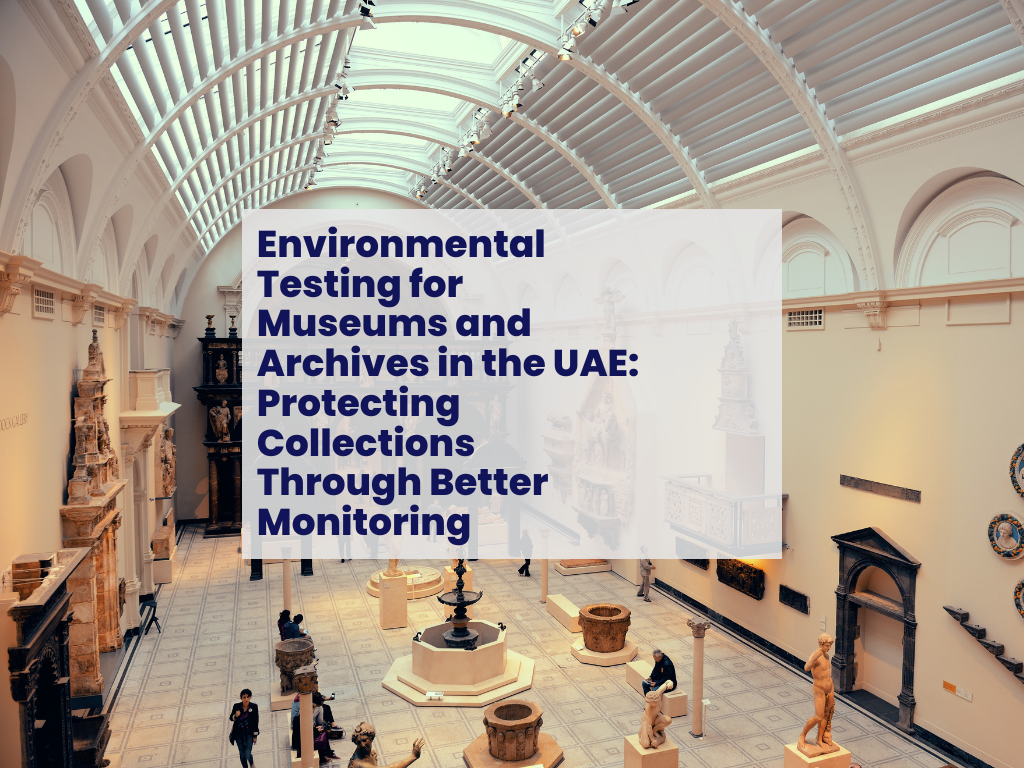
Museums, archives and galleries protect items that cannot easily be replaced. Historical documents, books, photographs, paintings, textiles, sculptures, manuscripts, artefacts and digital media can all be affected by the environment around them. Temperature, humidity, light, vibration and air quality may seem like background conditions, but over time they can directly influence the condition and lifespan of valuable collections.
In the UAE, environmental control is especially important because high outdoor temperatures, humidity, strong sunlight, air-conditioning demand and modern glass-heavy buildings can create challenging conditions for collection spaces. Even when a gallery or archive feels comfortable for visitors, it may not be suitable for long-term preservation.
RMT provides environmental testing for museums and archives in the UAE, helping organisations measure and understand the indoor conditions that affect collections, staff, visitors and building performance.
What poor environmental conditions do to museums and archives
Poor environmental conditions can damage collections gradually. In many cases, the problem is not a single incident, but repeated exposure to unsuitable conditions over months or years.
High humidity can contribute to mould risk, damp materials, corrosion, swelling, staining and deterioration. Low humidity can cause drying, cracking, brittleness and shrinkage in sensitive materials. Temperature changes can speed up chemical deterioration and may also cause materials to expand and contract.
Light exposure is another major issue. Strong light, direct sunlight and ultraviolet exposure can fade pigments, discolour paper, weaken textiles and damage photographs. Unlike some comfort issues, light damage is usually permanent.
Vibration can also be a concern. Nearby construction, roads, plant rooms, machinery, visitor movement or building services may affect fragile objects, display cases, shelves or sensitive equipment. Even low-level vibration can become important when collections are delicate, unstable or valuable.
Poor environmental control can lead to:
- fading of artworks, textiles and documents;
- mould growth or musty odours;
- cracking, warping or brittleness;
- corrosion of metals;
- deterioration of paper, photographs and bindings;
- condensation inside storage or display areas;
- increased pest and moisture risk;
- damage to fragile objects from vibration;
- complaints from staff or visitors about comfort;
- difficulty proving that collections are being properly protected.
For museums and archives, these risks matter because collection damage is often irreversible. Environmental testing helps identify risks early, before they become visible or costly.
Why good environmental control is important
Good environmental control protects collections while also supporting visitor comfort, staff working conditions and building performance. The goal is not always to create one fixed condition for every space. Different materials may have different needs, and modern conservation practice increasingly focuses on suitable, stable, risk-based environmental ranges rather than chasing one exact setpoint.
The National Archives and Records Administration notes that temperature and relative humidity guidance for archival storage has moved away from single setpoints and toward bands, because different materials have different requirements and previous storage conditions can also affect future storage needs.
Good environmental monitoring helps museums and archives:
- protect collections from long-term deterioration;
- identify areas with unstable humidity or temperature;
- reduce mould, dampness and condensation risk;
- manage light exposure in galleries and display cases;
- assess vibration risks from nearby activity or building systems;
- support conservation planning;
- provide evidence for audits, insurers, donors or stakeholders;
- improve HVAC and facilities decision-making;
- balance preservation needs with energy efficiency.
Environmental testing is important because many risks are invisible at first. A room may look suitable, but monitoring may reveal daily humidity swings, hot perimeter zones, excessive light on sensitive objects or vibration from nearby equipment.
Ideal environmental values for museums and archives
There is no single universal environmental value that suits every collection. A general office comfort range is not enough for museum and archive preservation. The correct target depends on the materials stored, the sensitivity of the collection, visitor access, building limitations, conservation advice and institutional risk tolerance.
However, recognised guidance is useful for setting practical benchmarks.
Temperature and humidity
For archive storage, NARA guidance highlights that preservation standards now focus on acceptable temperature and relative humidity ranges rather than one fixed setpoint. It also states that different materials have different requirements, and that temperature and humidity guidance should balance long-term preservation with energy efficiency.
For museums, sector guidance also emphasises that temperature and relative humidity affect collection care, and that monitoring and stable conditions are important in galleries, stores and display cases.
As a general preservation principle:
Stable conditions are usually more important than constant adjustment.
Large or repeated fluctuations in temperature and humidity can be more damaging than a controlled range that is appropriate for the collection.
For UAE museums and archives, testing should therefore look at:
- average temperature;
- average relative humidity;
- daily and weekly fluctuations;
- differences between galleries, stores and display cases;
- high-risk areas near windows, doors, AC diffusers or external walls;
- periods when HVAC systems are turned down or switched off;
- humidity levels during high occupancy or seasonal changes.
Lighting
Lighting targets should depend on the sensitivity of the object. Paper, textiles, photographs and some pigments are much more sensitive to light than stone, metal or ceramics.
For general workplace lighting, offices often use a target of 300 to 500 lux at the working plane. However, museum displays may require much lower light levels for sensitive objects. This is why lighting testing in museums should not only measure whether a space is bright enough for visitors, but whether the collection is being exposed to unnecessary light.
Lighting assessments should consider:
- visible light levels in lux;
- direct sunlight;
- glare;
- UV exposure where relevant;
- length of exposure;
- display rotation;
- lighting angle;
- distance between lights and objects;
- whether sensitive objects are placed near windows or bright fittings.
Vibration
Vibration targets depend on the object, display method, building structure and source of vibration. A general vibration reading alone may not tell the full story. Museums and archives should be especially cautious where collections are fragile, cracked, loosely mounted, stacked, suspended or stored in high shelving.
Vibration testing should consider:
- whether vibration is continuous or intermittent;
- whether it comes from construction, traffic, plant rooms, pumps, lifts or visitor activity;
- whether display cases, shelving or storage systems amplify movement;
- whether vibration affects sensitive instruments, artefacts or conservation work;
- whether works are being transported, installed or stored near vibration sources.
Why environmental readings alone are not enough
Environmental testing should not be treated as a simple pass-or-fail exercise. A single temperature, humidity, lux or vibration reading is useful, but museums and archives need context.
For example, a room may have acceptable humidity during a short inspection but may rise above safe levels overnight or during weekends. A gallery may have acceptable lighting in one area but excessive sunlight on one display case. An archive store may feel cool but experience frequent humidity fluctuations because of AC cycling or poor sealing.
A proper assessment should consider:
- the type of collection;
- the sensitivity of the materials;
- whether objects are on display or in storage;
- whether readings are stable over time;
- whether conditions change during opening hours;
- whether HVAC operation is continuous or scheduled;
- whether sunlight enters at certain times of day;
- whether display cases create microclimates;
- whether visitors, doors or loading areas affect conditions;
- whether nearby construction or plant causes vibration.
This is why environmental testing for museums and archives should be practical and risk-based. The aim is to identify what could damage the collection, not simply to collect numbers.
How to improve environmental conditions in different situations
Environmental problems in museums and archives can have different causes. The right solution depends on the collection, building, HVAC system, display layout and risk level.
If humidity is too high
High humidity is one of the most serious issues for collections because it can increase the risk of mould, corrosion and damp-related deterioration.
Possible improvements include:
- checking HVAC dehumidification performance;
- inspecting AC drainage and drip trays;
- sealing uncontrolled outdoor air entry;
- checking for leaks or damp building materials;
- improving ventilation control;
- reducing door openings to humid external air;
- using controlled storage or display cases;
- monitoring humidity continuously in high-risk rooms.
In UAE buildings, humidity problems may appear when AC systems are not removing enough moisture or when humid outdoor air enters through doors, loading areas or poorly sealed spaces.
If humidity is too low
Very low humidity can dry out sensitive organic materials such as paper, wood, leather, textiles and parchment. It may cause brittleness, cracking or shrinkage.
Possible improvements include:
- reviewing whether AC is over-drying the space;
- avoiding rapid humidity changes;
- improving local storage conditions;
- using suitable enclosures for sensitive objects;
- consulting a conservator before introducing humidification;
- monitoring whether low humidity is seasonal or constant.
Any corrective action should be controlled carefully, because sudden humidity increases can create new risks.
If temperature is unstable
Temperature affects both comfort and preservation. Higher temperatures can speed up chemical deterioration, while rapid temperature changes can contribute to physical stress in some materials.
Possible improvements include:
- reviewing HVAC schedules;
- reducing temperature swings between day and night;
- checking whether systems are turned off after hours;
- improving zoning between public and storage spaces;
- keeping sensitive collections away from external walls and windows;
- reviewing heat from lighting, equipment or high occupancy.
For archives and stores, stable conditions are often more important than matching a visitor comfort setpoint.
If light exposure is too high
Light damage is cumulative and often irreversible. Sensitive collections should not be exposed to unnecessary brightness or direct sunlight.
Possible improvements include:
- reducing light levels on sensitive objects;
- using blinds, films or shading;
- removing direct sunlight from display areas;
- using UV-filtering where required;
- adjusting spotlight angles;
- limiting display duration for sensitive materials;
- rotating sensitive items;
- using replicas for long-term display where appropriate;
- switching lights off when galleries or stores are unoccupied.
Lighting should support visitor experience without exposing collections to avoidable damage.
If vibration is affecting collections
Vibration may come from traffic, construction, building plant, lifts, pumps, generators, visitor movement or nearby machinery.
Possible improvements include:
- identifying the source of vibration;
- relocating fragile items away from vibration paths;
- improving display case or shelving stability;
- using suitable mounts and supports;
- separating collections from plant rooms or mechanical spaces;
- scheduling high-vibration work outside sensitive periods;
- monitoring vibration during construction or maintenance projects.
This is especially important during renovations, nearby construction, object movement, exhibition installation or building works.
If storage areas are not controlled properly
Archives and storage rooms often hold the most sensitive and valuable items, but they may receive less attention than public galleries.
Possible improvements include:
- monitoring temperature and humidity over time;
- separating storage from uncontrolled spaces;
- improving sealing around doors;
- keeping collections away from floors, external walls and AC outlets;
- using appropriate shelving and enclosures;
- reducing unnecessary light exposure;
- checking for damp, pests and condensation;
- creating different storage zones for different material types.
Storage areas should be tested regularly because damage can develop slowly and may not be noticed until it is advanced.
Why museums and archives in the UAE should test environmental conditions
Environmental testing is especially valuable in the UAE because local conditions can place additional pressure on museums, galleries and archive facilities. High external humidity, strong sunlight, heavy HVAC use, rapid indoor-outdoor changes and construction activity can all affect preservation environments.
Museums and archives should consider environmental testing when:
- collections include paper, photographs, textiles, leather, wood or paintings;
- there are signs of mould, dampness, fading or cracking;
- staff notice musty smells or condensation;
- galleries have direct sunlight or bright display lighting;
- storage rooms are near external walls, entrances or plant areas;
- HVAC systems are being adjusted, replaced or switched off after hours;
- a new exhibition is being installed;
- construction or vibration sources are nearby;
- the organisation needs evidence for conservation planning, insurance, audits or stakeholder reporting;
- valuable collections are stored long-term.
Environmental testing gives museums and archives the data needed to protect collections before damage becomes visible.
Environmental testing by RMT in the UAE
RMT provides environmental testing for museums, galleries and archives in the UAE, including temperature, humidity, lighting, noise and vibration assessment.
Our testing helps cultural institutions understand whether indoor conditions are suitable for collections, where environmental risks exist, and what practical improvements may be needed.
For museums and archives, environmental testing is not just a building service. It is part of responsible collection care. By measuring conditions properly, organisations can protect valuable materials, support conservation decisions and preserve cultural heritage for the future.


No responses yet