

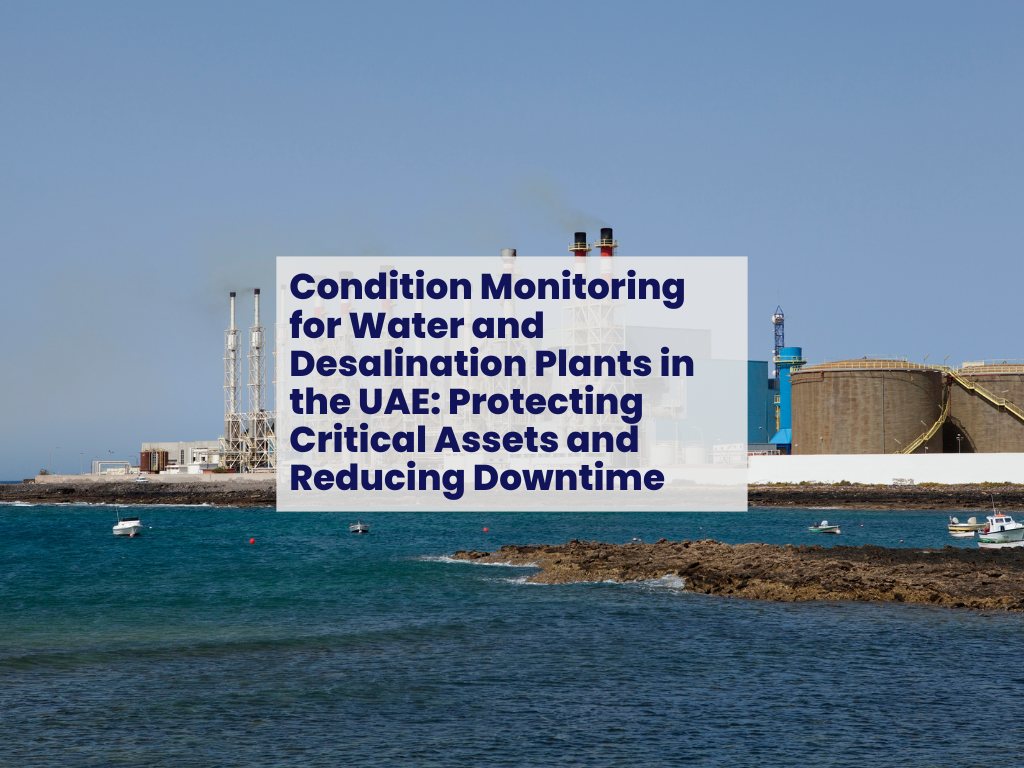
Water and desalination plants are critical infrastructure. They support drinking water supply, industrial operations, utilities, communities and essential services across the UAE. Because these plants often operate continuously, equipment reliability is extremely important.
Pumps, motors, compressors, blowers, fans, gearboxes, valves, electrical panels, membranes, dosing systems and auxiliary equipment all need to perform reliably. When one critical asset fails, the impact can extend across the entire plant, causing reduced production, emergency maintenance, process disruption and higher operating costs.
RMT provides condition monitoring for water and desalination plants in the UAE, helping plant managers, maintenance teams and reliability engineers detect developing faults before they lead to unplanned downtime.
What poor condition monitoring does to water and desalination plants
Water and desalination plants depend on continuous operation. Many systems are connected, meaning that a fault in one area can affect the wider process.
For example, a bearing fault on a pump, vibration on a motor, overheating in an electrical panel, misalignment on a drive system or cavitation in a pump can all reduce reliability. If these issues are not detected early, they can lead to equipment failure, production loss and emergency repair work.
Poor condition monitoring can lead to:
- unexpected shutdowns;
- reduced water production;
- emergency maintenance costs;
- repeated pump and motor failures;
- membrane process disruption;
- increased energy consumption;
- poor equipment availability;
- higher spare parts usage;
- safety risks for maintenance teams;
- difficulty planning shutdowns;
- reduced confidence in plant reliability.
In desalination plants, equipment often operates under demanding conditions such as high flow rates, pressure changes, humidity, salt exposure, chemical dosing and continuous duty. These conditions make early fault detection especially valuable.
Why condition monitoring is important
Condition monitoring gives maintenance teams measurable information about the health of critical assets. Instead of waiting for failure, plant teams can identify early warning signs and plan corrective action.
This is especially important in water and desalination plants because many assets are production-critical. A failed high-pressure pump, intake pump, booster pump, motor, compressor or electrical panel can affect the plant’s ability to operate efficiently.
Condition monitoring helps plants:
- reduce unplanned downtime;
- improve asset availability;
- detect faults before failure;
- plan maintenance during scheduled shutdowns;
- reduce emergency repairs;
- extend equipment life;
- improve energy efficiency;
- support predictive maintenance;
- reduce maintenance costs;
- prioritise high-risk assets;
- improve reliability reporting.
The main benefit is that maintenance becomes more controlled. Instead of reacting to breakdowns, plant teams can use condition data to decide when to repair, monitor or replace equipment.
Key equipment that should be monitored
Water and desalination plants contain many assets that benefit from condition monitoring. The most important assets are usually rotating, electrical and process-critical systems.
Pumps
Pumps are among the most important assets in water and desalination plants. This includes intake pumps, transfer pumps, booster pumps, high-pressure pumps, dosing pumps and circulation pumps.
Condition monitoring can help detect:
- bearing wear;
- cavitation;
- misalignment;
- imbalance;
- looseness;
- seal problems;
- abnormal vibration;
- overheating;
- flow-related issues.
Because pumps are central to water movement and pressure control, early detection of pump issues can prevent major disruption.
Motors
Electric motors drive pumps, fans, compressors, conveyors and auxiliary systems. Motor failure can stop critical equipment immediately.
Monitoring can help identify:
- bearing defects;
- overheating;
- vibration;
- electrical imbalance;
- poor cooling;
- misalignment with driven equipment;
- load-related stress.
Motor condition monitoring is especially valuable for equipment that operates continuously.
High-pressure systems
Reverse osmosis desalination plants rely on high-pressure systems. These assets operate under demanding loads and are critical to production.
Monitoring can help identify abnormal vibration, pressure-related stress, pump wear, motor issues and developing mechanical faults before they affect plant output.
Compressors and blowers
Compressors and blowers may support air systems, treatment processes, instrumentation or plant utilities.
Condition monitoring can detect:
- bearing issues;
- overheating;
- imbalance;
- lubrication problems;
- abnormal vibration;
- restricted airflow;
- motor faults.
Fans and HVAC systems
Plant buildings, control rooms, electrical rooms and equipment spaces often depend on ventilation and HVAC systems. In the UAE, reliable cooling is especially important for electrical and control equipment.
Monitoring can help detect fan imbalance, motor overheating, bearing wear, blocked filters and abnormal vibration.
Gearboxes and drive systems
Gearboxes are used in many plant applications. They can be expensive to repair and may have long lead times for replacement.
Condition monitoring can identify:
- gear wear;
- bearing defects;
- lubrication issues;
- misalignment;
- overheating;
- abnormal vibration.
Electrical panels and switchgear
Electrical reliability is essential for continuous plant operation. Overheating panels, loose connections, overloaded circuits or failing components can create downtime and safety risks.
Thermography inspections can help identify abnormal heat in panels, breakers, terminals, busbars and switchgear before failure occurs.
Valves and process equipment
Valves, actuators and process equipment are important for controlling flow, pressure and treatment performance. Monitoring can help identify abnormal operation, leakage, vibration, wear or control issues.
Main condition monitoring methods for water and desalination plants
Condition monitoring should be selected based on the equipment type, operating conditions and plant criticality. In water and desalination plants, the most useful methods often include vibration analysis, thermography, ultrasound, alignment checks, lubrication review and trend monitoring.
Vibration analysis
Vibration analysis is one of the most important tools for monitoring rotating equipment.
It can help detect:
- imbalance;
- misalignment;
- bearing defects;
- looseness;
- cavitation;
- resonance;
- gear wear;
- foundation issues;
- soft foot;
- coupling problems.
Vibration analysis is especially useful for pumps, motors, gearboxes, compressors, fans and blowers. By trending vibration over time, maintenance teams can identify whether equipment is stable or deteriorating.
Thermography
Infrared thermography detects abnormal heat in electrical and mechanical assets. In water and desalination plants, overheating can indicate developing faults before equipment fails.
Thermography can help identify:
- loose electrical connections;
- overloaded circuits;
- overheating motors;
- hot bearings;
- poor lubrication;
- failing breakers;
- abnormal heat in switchgear;
- cooling problems;
- overloaded panels.
This method is useful because many inspections can be performed while equipment is operating.
Ultrasound inspection
Ultrasound can support condition monitoring by detecting high-frequency sounds linked to leaks, bearing defects, steam traps, compressed air losses or electrical discharge.
In water and desalination plants, ultrasound can help identify:
- air leaks;
- valve leakage;
- bearing issues;
- cavitation indicators;
- electrical faults;
- compressed air losses.
This can help reduce wasted energy and support early fault detection.
Laser alignment
Misalignment is a common cause of vibration, bearing damage, seal failure and coupling wear. Laser alignment helps ensure that connected equipment is correctly aligned.
This is important for:
- pump and motor sets;
- compressor and motor sets;
- gearbox-driven systems;
- fan drives;
- rotating equipment after maintenance or installation.
Correct alignment improves reliability, reduces vibration and helps extend equipment life.
Lubrication review
Poor lubrication is a major cause of bearing and gearbox failure. Water and desalination plants may also face humidity, contamination and chemical exposure, which can affect lubricant condition.
Lubrication review can help identify:
- insufficient lubrication;
- over-greasing;
- wrong lubricant type;
- contamination;
- water ingress;
- degraded oil;
- poor lubrication intervals.
Good lubrication practices help reduce friction, heat and premature wear.
Trend monitoring
A single reading is useful, but trend monitoring is more powerful. By collecting data regularly, plant teams can see whether an asset is stable, improving or deteriorating.
Trend monitoring helps maintenance teams:
- plan repairs before failure;
- prioritise critical equipment;
- avoid unnecessary maintenance;
- justify spare parts;
- schedule shutdown work;
- track whether corrective actions were successful.
Why readings alone are not enough
Condition monitoring is not just about collecting vibration, temperature or ultrasound readings. The value comes from interpreting the data in the context of the equipment and the process.
A pump may show higher vibration because of cavitation, misalignment, looseness or a bearing defect. A motor may run hot because of overload, poor cooling, electrical imbalance or environmental conditions. A thermal image may show a hot component, but the severity depends on load, design and comparison with similar components.
A proper condition monitoring assessment should consider:
- equipment type;
- operating speed;
- load condition;
- process demand;
- asset criticality;
- previous failure history;
- vibration trends;
- temperature patterns;
- lubrication condition;
- maintenance history;
- production impact if the asset fails.
This is why condition monitoring should be linked to plant operations and maintenance planning. The aim is not only to measure assets, but to help the plant make better reliability decisions.
How to improve reliability in different situations
Different condition monitoring findings require different actions. The correct response depends on the asset, fault type, severity and plant impact.
If pumps show high vibration
High vibration in pumps may be caused by cavitation, imbalance, misalignment, bearing wear, looseness, pipe strain or foundation issues.
Possible actions include:
- carrying out detailed vibration analysis;
- checking alignment;
- inspecting bearings;
- reviewing pump operating point;
- checking suction conditions;
- investigating cavitation;
- checking foundation bolts;
- reviewing pipe supports;
- monitoring vibration trends.
Pump vibration should be investigated early because it can damage bearings, seals, couplings and connected equipment.
If motors are overheating
Motor overheating may be caused by overload, poor ventilation, electrical imbalance, bearing problems, misalignment or excessive ambient temperature.
Possible actions include:
- using thermography to identify heat patterns;
- checking motor load;
- inspecting cooling and ventilation;
- reviewing electrical connections;
- checking vibration levels;
- inspecting bearings;
- checking alignment with the driven asset;
- cleaning blocked cooling fins where appropriate.
In UAE plants, heat and continuous operation make motor temperature monitoring especially important.
If electrical panels show hot spots
Electrical hot spots can indicate loose connections, overloaded circuits, corroded terminals, poor contact or failing components.
Possible actions include:
- planning corrective work based on severity;
- tightening or repairing connections;
- checking load balance;
- inspecting breakers and terminals;
- reviewing panel ventilation;
- rechecking the component after repair.
Electrical thermography helps reduce the risk of sudden electrical failure and supports safer maintenance planning.
If bearings fail repeatedly
Repeated bearing failures usually mean there is an underlying cause. Simply replacing the bearing may not solve the problem.
Possible causes include:
- misalignment;
- poor lubrication;
- contamination;
- water ingress;
- excessive load;
- vibration;
- incorrect installation;
- seal failure;
- unsuitable bearing selection.
Condition monitoring helps identify the root cause and prevent repeat failures.
If cavitation is suspected
Cavitation can damage pumps and reduce performance. It may cause vibration, noise, reduced flow, seal damage and impeller wear.
Possible actions include:
- checking suction conditions;
- reviewing pump operating point;
- inspecting filters or strainers;
- checking for restrictions;
- reviewing valve positions;
- checking vibration and ultrasound indicators;
- inspecting the pump during planned maintenance.
Detecting cavitation early helps protect pump components and maintain process reliability.
If equipment condition is deteriorating over time
A gradual increase in vibration, temperature or abnormal sound may indicate a developing fault.
Possible actions include:
- increasing monitoring frequency;
- planning inspection during the next shutdown;
- ordering spare parts in advance;
- comparing readings with similar assets;
- reviewing maintenance history;
- deciding whether immediate action or continued monitoring is required.
Trend data helps avoid both unnecessary repairs and unexpected failures.
Why water and desalination plants in the UAE should invest in condition monitoring
Water and desalination plants in the UAE operate in demanding conditions. High temperatures, humidity, salt exposure, continuous operation and critical service requirements all increase the importance of reliable equipment.
Plants should consider condition monitoring when:
- pumps, motors, compressors or fans run continuously;
- equipment failure would reduce water production;
- vibration, noise or overheating is reported;
- bearings, seals or couplings fail repeatedly;
- electrical panels are critical to operation;
- maintenance teams want to move from reactive to predictive maintenance;
- shutdown planning needs better asset condition data;
- energy efficiency and equipment performance need improvement;
- management needs evidence to justify repairs or replacements;
- plant availability is a priority.
Condition monitoring gives water and desalination plants the data needed to protect production, reduce downtime and improve long-term reliability.
Condition monitoring by RMT for water and desalination plants in the UAE
RMT provides condition monitoring for water and desalination plants in the UAE, supporting plant managers, maintenance teams and reliability engineers with practical, data-driven insight.
Our services can support pumps, motors, compressors, blowers, fans, gearboxes, electrical panels, high-pressure systems and other critical plant assets.
By using vibration analysis, thermography, ultrasound, alignment checks, lubrication review and trend monitoring, water and desalination plants can reduce downtime, improve asset performance and make maintenance decisions based on measured evidence rather than guesswork.
For UAE water and desalination facilities, condition monitoring is a practical way to protect critical infrastructure, improve reliability and maintain confidence in continuous operation.


No responses yet