

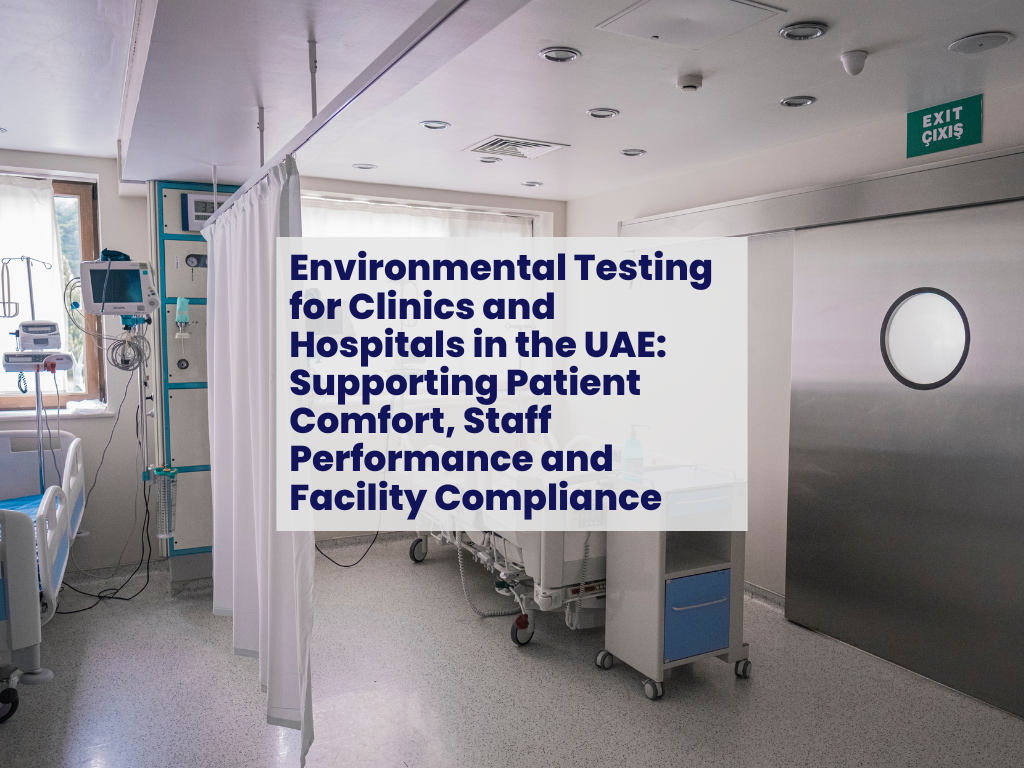
Clinics and hospitals depend on controlled indoor environments. Patients, doctors, nurses, visitors, laboratory teams and support staff all rely on spaces that are comfortable, safe and suitable for healthcare activities.
Temperature, humidity, lighting, noise, vibration and indoor air quality can all affect how a healthcare facility performs. A consultation room that is too warm, a waiting area with poor ventilation, a treatment room with glare, a noisy recovery area, or vibration affecting sensitive equipment can all create operational and comfort issues.
RMT provides environmental testing for clinics and hospitals in the UAE, helping healthcare facilities assess indoor conditions using measured data and recognised environmental benchmarks.
What poor environmental conditions do to clinics and hospitals
Poor environmental conditions can affect patient comfort, staff efficiency, equipment reliability and the overall quality of the healthcare environment.
In healthcare settings, environmental issues may include:
- consultation rooms that are too hot or too cold;
- waiting areas that feel humid, stale or uncomfortable;
- treatment rooms with glare or poor lighting;
- noisy areas affecting patient comfort and communication;
- vibration affecting sensitive medical or laboratory equipment;
- high humidity that may contribute to dampness or odours;
- poor temperature control in pharmacies, laboratories or storage rooms;
- inconsistent comfort between patient areas, offices and clinical rooms.
These issues are especially important because healthcare buildings are used by people who may already be unwell, stressed or sensitive to discomfort. Staff also need suitable conditions to concentrate, communicate clearly and carry out clinical or administrative tasks accurately.
Why environmental testing is important in healthcare facilities
Environmental testing helps clinics and hospitals move from assumptions to evidence. Instead of relying only on complaints such as “this room feels humid” or “this area is too noisy,” testing provides measurable readings that can be compared with relevant guidance and site requirements.
Healthcare ventilation and environmental requirements can be room-specific. ASHRAE describes ANSI/ASHRAE/ASHE Standard 170 as a standard that provides minimum ventilation requirements for healthcare facilities, while DHA’s Health Facility Guidelines provide guidance for the briefing, design and construction of healthcare facilities licensed by Dubai Health Authority.
Environmental testing can support:
- patient comfort;
- staff working conditions;
- facilities management decisions;
- HVAC troubleshooting;
- indoor air quality reviews;
- HSE documentation;
- infection-control discussions;
- equipment protection;
- audit and compliance preparation;
- maintenance planning.
It is important to note that general environmental testing does not replace specialist validation for operating theatres, isolation rooms, cleanrooms or regulated clinical spaces. However, it provides valuable evidence for identifying comfort issues, environmental risks and building-performance problems.
Key environmental factors clinics and hospitals should monitor
Temperature
Temperature is one of the most common comfort issues in healthcare buildings. Consultation rooms, waiting areas, wards, offices and treatment rooms may all experience different temperature conditions depending on occupancy, HVAC zoning, equipment heat, sunlight and airflow.
For general indoor comfort screening, RMT uses the UAE/Dubai IAQ temperature range of 22.5°C to 25.5°C dry-bulb temperature. This is most useful for general occupied areas such as offices, waiting areas and support spaces.
Temperature testing is useful when:
- patients or staff complain that areas are too hot or too cold;
- rooms become uncomfortable during busy periods;
- HVAC zones perform inconsistently;
- areas near windows are affected by solar gain;
- cold air blows directly onto occupants;
- storage or pharmacy areas require closer monitoring;
- temperature complaints are repeated after HVAC adjustments.
In healthcare settings, temperature should always be reviewed in relation to the actual room function. A general office, consultation room, pharmacy, laboratory, treatment room and operating theatre may all have different requirements.
Humidity
Humidity affects comfort, indoor air quality and building condition. In UAE clinics and hospitals, humidity control is especially important because air-conditioning and dehumidification systems operate heavily for much of the year.
For general indoor comfort screening, RMT uses a target range of 20% to 60% relative humidity, with sustained readings above 60% RH treated as an issue requiring investigation.
High humidity may indicate:
- poor AC dehumidification;
- drainage issues;
- water leaks;
- condensation;
- outdoor air infiltration;
- poor ventilation;
- damp finishes or materials.
Low humidity may contribute to dryness, irritation or discomfort for staff and patients.
Humidity testing is useful when there are musty odours, condensation, damp ceiling tiles, complaints about dryness, or areas that feel heavy, stale or uncomfortable.
Indoor air quality and ventilation
Indoor air quality is especially important in healthcare environments because patients, visitors and staff spend time in enclosed spaces where ventilation, filtration, humidity and cleanliness all matter.
The CDC’s environmental infection control guidance provides recommendations for healthcare facilities, and ASHRAE Standard 170 is specifically focused on ventilation requirements for healthcare facilities.
IAQ testing may consider:
- temperature;
- humidity;
- ventilation performance indicators;
- CO₂ levels where relevant;
- odours;
- dust or particles;
- signs of dampness;
- HVAC operation;
- filtration and maintenance condition;
- differences between rooms and zones.
IAQ testing is particularly useful in waiting rooms, consultation rooms, laboratories, staff areas, pharmacies, treatment rooms and high-occupancy spaces.
Lighting
Lighting affects visual comfort, task accuracy and patient experience. Poor lighting can cause glare, eye strain, shadows and discomfort. In healthcare environments, lighting must support both clinical tasks and patient comfort.
For general office and workstation areas, RMT uses a target range of 300 to 500 lux at the working plane. However, clinical spaces may require different lighting depending on the task being carried out.
Lighting testing is useful when:
- staff report eye strain or headaches;
- screens have glare or reflections;
- treatment areas have shadows;
- examination or work surfaces are poorly lit;
- waiting areas feel too dim or too harsh;
- sunlight creates glare;
- task lighting may be required.
Lighting should not only be assessed by brightness. Glare, contrast, screen reflections, direct sunlight and workstation layout should also be reviewed.
Noise
Noise affects communication, privacy, patient comfort and staff concentration. In healthcare settings, noise can come from conversations, waiting areas, medical equipment, alarms, HVAC systems, printers, trolleys, doors, plant rooms and external traffic.
For general office-style areas, RMT uses an open-plan comfort benchmark of approximately 45 to 50 dB(A) LAeq,T, especially where concentration and privacy are important.
Noise testing is useful when:
- conversations can easily be overheard;
- reception or waiting areas are too loud;
- staff struggle to concentrate;
- consultation rooms lack acoustic privacy;
- HVAC systems create constant background noise;
- patients complain about noise;
- equipment or alarms create repeated disturbance.
In clinics and hospitals, noise is not only a comfort issue. It can affect communication quality, patient experience and confidentiality.
Vibration
Vibration can affect patient comfort, building performance and sensitive equipment. It may come from HVAC plant, pumps, compressors, lifts, nearby roads, construction work, generators or machinery.
Vibration testing is useful when:
- vibration is felt through floors, chairs or beds;
- medical or laboratory equipment is sensitive to movement;
- construction is taking place nearby;
- plant rooms are close to clinical areas;
- staff report vibration from building services;
- diagnostic or laboratory equipment is giving inconsistent readings.
In healthcare facilities, vibration should be taken seriously because it can affect both comfort and equipment reliability.
Why readings alone are not enough
Environmental testing in healthcare facilities should not be treated as a simple pass-or-fail exercise. The same reading can mean different things depending on the room type and how the space is used.
For example, a temperature reading that is acceptable in an office may not be suitable for a pharmacy, laboratory or treatment room. A noise level that is acceptable in a reception area may be unsuitable near consultation rooms. A lighting level that works in an admin office may not be enough for a clinical task.
A proper healthcare environmental assessment should consider:
- room function;
- occupancy levels;
- patient sensitivity;
- staff tasks;
- HVAC operation;
- ventilation and filtration;
- infection-control requirements;
- clinical equipment;
- temperature and humidity stability;
- noise sources;
- lighting needs;
- vibration risks;
- applicable authority or facility-specific requirements.
This is why environmental testing should be practical, room-specific and linked to the actual use of the healthcare space.
How to improve conditions in different healthcare situations
If waiting areas feel uncomfortable
Waiting areas can become uncomfortable because of high occupancy, poor airflow, humidity, external heat gain or inadequate HVAC control.
Possible improvements include:
- reviewing temperature and humidity readings during busy periods;
- checking ventilation and air distribution;
- improving HVAC balancing;
- reducing solar gain with blinds or shading;
- checking whether doors are allowing humid outdoor air inside;
- reviewing occupancy and seating layout.
If consultation rooms are too noisy
Consultation rooms require speech privacy and clear communication. Noise from corridors, waiting areas, HVAC systems or adjacent rooms can affect both patient experience and confidentiality.
Possible improvements include:
- checking background noise levels;
- reviewing door seals;
- improving acoustic separation;
- relocating noisy equipment;
- reducing corridor noise;
- improving wall, ceiling or door acoustic performance;
- reviewing HVAC noise.
If treatment rooms have poor lighting
Treatment rooms may need lighting that supports clinical tasks without creating glare or discomfort.
Possible improvements include:
- measuring lux levels at the working plane;
- adding task lighting where needed;
- reducing glare from windows or fittings;
- repositioning light sources;
- reviewing shadows on work surfaces;
- checking screen reflections;
- improving lighting uniformity.
If humidity is high or there are musty odours
High humidity and musty odours should be investigated because they may indicate moisture, drainage or HVAC issues.
Possible improvements include:
- checking AC drainage and drip trays;
- reviewing dehumidification performance;
- inspecting ceiling tiles, carpets and walls;
- checking for leaks;
- improving ventilation;
- reducing uncontrolled outdoor air entry;
- monitoring humidity over time.
If HVAC systems are causing complaints
HVAC systems can create temperature, humidity, noise and airflow issues if they are poorly balanced or not operating correctly.
Possible improvements include:
- testing temperature and humidity across multiple rooms;
- checking diffuser locations;
- reviewing air balancing;
- inspecting filters and maintenance condition;
- checking fan or motor noise;
- reviewing control settings;
- comparing readings during peak and low occupancy.
If sensitive equipment is affected
Laboratory, diagnostic or monitoring equipment may be sensitive to temperature, humidity, vibration or dust.
Possible improvements include:
- monitoring environmental conditions around equipment;
- checking vibration sources;
- reviewing equipment room HVAC;
- improving stability of temperature and humidity;
- reducing nearby mechanical vibration;
- checking filtration and dust control;
- following equipment manufacturer requirements.
Why clinics and hospitals in the UAE should test environmental conditions
Healthcare facilities in the UAE face specific environmental challenges. High outdoor temperatures, humidity, dust, strong sunlight and heavy air-conditioning demand can all affect indoor performance.
Clinics and hospitals should consider environmental testing when:
- patients or staff complain about discomfort;
- waiting areas feel humid, hot, cold or stale;
- consultation rooms lack privacy or are too noisy;
- treatment rooms have glare or poor lighting;
- HVAC complaints are repeated;
- condensation, dampness or odours are present;
- sensitive medical or laboratory equipment is affected;
- renovation or fit-out work has recently been completed;
- HSE, infection-control or facilities teams need supporting evidence;
- management needs data before approving corrective action.
Environmental testing helps healthcare facilities identify issues early and respond with measured evidence rather than assumptions.
Environmental testing by RMT for clinics and hospitals in the UAE
RMT provides environmental testing for clinics and hospitals in the UAE, including temperature, humidity, lighting, noise, vibration and indoor air quality assessment.
Our testing supports healthcare facilities by helping identify comfort issues, building-performance problems, HVAC concerns and environmental risks that may affect patients, staff or equipment.
For clinics and hospitals, environmental testing is not only about comfort. It supports patient experience, staff performance, facilities management and confidence that indoor conditions are being properly monitored and managed.


No responses yet