

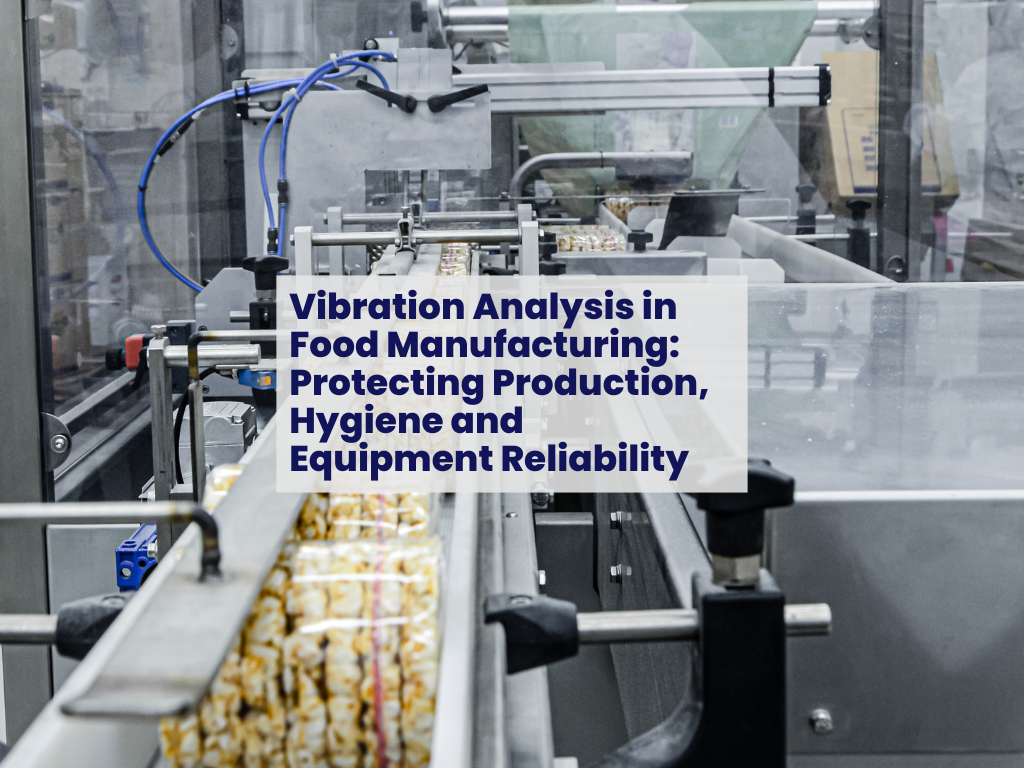
Food manufacturing facilities depend on reliable equipment. Mixers, conveyors, pumps, motors, gearboxes, fans, compressors, packaging lines, filling machines and refrigeration systems all need to operate consistently to keep production moving.
When vibration levels increase, it is often an early sign that something is wrong. A bearing may be wearing, a motor may be misaligned, a fan may be unbalanced, a gearbox may be deteriorating, or a pump may be operating outside its ideal condition. If these issues are ignored, they can lead to breakdowns, production stoppages, contamination risks, product loss and higher maintenance costs.
RMT provides vibration analysis for food manufacturing facilities in the UAE, helping maintenance teams detect developing equipment faults before they turn into unplanned downtime.
What poor vibration control does to food manufacturing facilities
Vibration is not just a mechanical issue. In food manufacturing, excessive vibration can affect production reliability, product quality, hygiene, safety and maintenance planning.
Food production lines often run continuously or for long shifts. A small issue on one machine can quickly affect the whole line. For example, a conveyor motor fault can stop product movement, a pump failure can affect processing or cleaning systems, and a packaging machine vibration issue can cause rejected products or line interruptions.
Poor vibration control can lead to:
- unplanned downtime;
- repeated bearing failures;
- gearbox wear;
- motor damage;
- conveyor problems;
- pump and seal failures;
- packaging line instability;
- poor product handling;
- loose guards, mounts or fasteners;
- increased noise;
- higher energy use;
- emergency maintenance during production;
- possible hygiene and contamination concerns.
In food manufacturing, equipment must be maintained in a way that protects against contamination and supports hygienic operation. FDA food cGMP requirements state that equipment used in food manufacturing, processing, packing or holding must be adequately maintained to protect against allergen cross-contact and contamination, and that equipment should be designed and used to avoid contamination from sources such as lubricants, fuel, metal fragments or contaminated water.
This is why vibration problems should not be ignored. A developing mechanical fault may eventually create not only downtime, but also hygiene, maintenance and product-quality concerns.
Why vibration analysis is important in food manufacturing
Vibration analysis helps maintenance teams identify faults while equipment is still operating. Instead of waiting for a machine to fail, teams can detect early warning signs and plan corrective action at a suitable time.
This is especially useful in food manufacturing because production schedules are often tight. Many facilities need to manage cleaning windows, product changeovers, chilled storage, packaging deadlines and delivery requirements. A sudden breakdown can disrupt the entire production plan.
Vibration analysis helps food manufacturers:
- reduce unplanned downtime;
- detect bearing faults early;
- identify misalignment and imbalance;
- protect motors, pumps, conveyors and gearboxes;
- plan repairs during scheduled maintenance windows;
- reduce emergency intervention in production areas;
- improve equipment life;
- reduce product loss and rework;
- support predictive maintenance;
- improve line availability;
- provide evidence for maintenance decisions.
The UAE places strong emphasis on food safety across the supply chain. The UAE Government notes that food safety law and executive regulations are implemented through strict controls and standards to ensure food safety throughout the food chain. Vibration analysis supports this wider reliability culture by helping food manufacturers maintain equipment before failures affect production, hygiene or quality.
Key food manufacturing equipment that should be monitored
Food factories contain many assets that can benefit from vibration analysis. The highest priority is usually equipment that runs continuously, handles product, supports utilities, or would stop production if it failed.
Conveyors
Conveyors are used throughout food manufacturing for moving ingredients, products, trays, packaging and finished goods. Vibration problems may come from pulley misalignment, bearing wear, belt tracking issues, gearbox defects or motor faults.
Monitoring conveyors helps reduce the risk of line stoppages, belt damage, product spillage and repeated bearing failures.
Mixers and agitators
Mixers and agitators are critical in many food processes, including bakery, dairy, sauces, beverages, confectionery and prepared foods. Vibration may indicate imbalance, bearing wear, shaft issues, coupling problems, misalignment or product build-up.
Early detection helps prevent breakdowns during production and supports more controlled maintenance planning.
Pumps
Pumps may be used for water, cleaning systems, sauces, oils, dairy products, beverages, syrups, CIP systems and process transfer. Vibration issues can indicate cavitation, misalignment, bearing wear, seal problems, looseness or incorrect operating conditions.
Pump vibration should be investigated early because pump failure can affect production, cleaning, transfer and hygiene systems.
Motors
Motors drive conveyors, mixers, fans, pumps, compressors and packaging equipment. Vibration analysis can help identify bearing faults, imbalance, soft foot, misalignment and load-related stress.
Monitoring motors is especially important where a single motor failure can stop a full production line.
Gearboxes
Gearboxes are used across conveyors, mixers, packaging lines and drive systems. Gearbox faults can be costly and may require long repair or replacement times.
Vibration analysis can help detect gear wear, bearing defects, looseness, lubrication issues and abnormal mechanical patterns before failure becomes severe.
Fans, blowers and refrigeration equipment
Food manufacturing facilities often depend on ventilation, refrigeration and cooling systems. Fans and blowers can develop vibration due to imbalance, dust build-up, bearing wear, belt problems or motor faults.
Because temperature control is important for many food processes and storage areas, cooling and refrigeration support equipment should be treated as critical.
Packaging and filling machines
Packaging lines need stable operation to avoid rejected products, seal issues, incorrect filling, downtime and quality complaints. Vibration may affect rotating parts, bearings, drives, motors and mechanical assemblies.
Vibration monitoring helps identify developing faults before they create repeated line stops or quality problems.
Ideal vibration values and guideline references
Unlike lighting, temperature or humidity, vibration analysis does not use one simple universal value for every machine. The acceptable vibration level depends on machine type, size, speed, mounting, operating load and criticality.
ISO 20816-1 provides general conditions and procedures for measuring and evaluating vibration on complete machines using measurements on rotating, non-rotating and non-reciprocating parts. This makes it a useful reference when assessing machine vibration, but readings still need to be interpreted in the context of the specific asset.
In practice, vibration analysis normally considers:
Overall vibration level
Used as a general indication of machine condition and severity.
Vibration trend
A machine may still be running, but if vibration is increasing over time, it may be deteriorating.
Frequency analysis
Different fault types create different vibration patterns. This helps identify whether the issue may be imbalance, misalignment, bearing wear, looseness, gear defects or cavitation.
Machine type and speed
A small high-speed motor and a large slow-speed mixer cannot be judged in exactly the same way.
Operating condition
Readings should be considered alongside load, product type, production speed, cleaning condition and process state.
Criticality
A non-critical support fan and a production-line motor may require different action levels because the business impact of failure is different.
For food manufacturing, the ideal approach is not to rely only on a single alarm value. The best approach is to create a baseline for important machines, monitor changes over time, and investigate abnormal increases before failure occurs.
Why vibration readings alone are not enough
Vibration analysis is powerful, but the reading must be interpreted correctly. A high reading does not automatically identify the root cause, and a low reading does not always mean the machine has no issue.
For example, vibration on a conveyor may come from belt tracking, pulley wear, bearing defects, gearbox problems, loose mounts or product loading. A pump vibration issue may be caused by cavitation, misalignment, pipe strain or bearing wear. A mixer may vibrate differently depending on product viscosity, batch size or speed.
A proper vibration assessment should consider:
- machine type;
- operating speed;
- product load;
- production condition;
- cleaning cycle timing;
- mounting and foundation condition;
- bearing and lubrication history;
- previous failures;
- vibration trend;
- equipment criticality;
- food safety and hygiene impact;
- production impact if the asset fails.
This is especially important in food manufacturing because the same machine may operate differently depending on recipe, temperature, batch size, product viscosity or packaging speed.
How to improve vibration issues in different food manufacturing situations
Vibration problems can have different causes. The right corrective action depends on the machine, fault type, severity and production impact.
If conveyors are vibrating
Conveyor vibration may be caused by pulley misalignment, worn bearings, belt tracking issues, gearbox faults, loose supports or uneven loading.
Possible improvements include:
- checking pulley and roller bearings;
- reviewing belt tracking and tension;
- inspecting gearbox vibration;
- checking motor alignment;
- tightening loose supports or guards;
- reviewing product loading;
- monitoring vibration trends after adjustment.
In food manufacturing, conveyor vibration should be controlled because conveyors often connect different process stages. A conveyor failure can stop upstream and downstream operations.
If pumps show high vibration
Pump vibration may be caused by cavitation, misalignment, bearing wear, seal issues, pipe strain, imbalance or operation away from the pump’s preferred range.
Possible improvements include:
- carrying out detailed vibration analysis;
- checking pump and motor alignment;
- reviewing suction conditions;
- checking for cavitation;
- inspecting bearings and seals;
- checking pipe supports;
- reviewing flow and pressure conditions;
- monitoring after corrective action.
Pumps used for CIP, process transfer, cooling or ingredients should be prioritised because failure can affect production and hygiene systems.
If mixers or agitators are vibrating
Mixers and agitators may vibrate because of imbalance, shaft problems, bearing wear, coupling issues, product build-up, incorrect speed or uneven loading.
Possible improvements include:
- checking bearings and couplings;
- reviewing shaft condition;
- inspecting for product build-up;
- checking mounting points;
- reviewing operating speed;
- checking batch size and product consistency;
- monitoring vibration under normal production conditions.
Testing should ideally be carried out under representative production conditions, because a mixer may behave differently when empty compared with when it is processing product.
If motors are showing abnormal vibration
Motor vibration may be caused by bearing defects, imbalance, soft foot, misalignment, electrical issues or load from the driven equipment.
Possible improvements include:
- checking motor bearings;
- confirming alignment with the driven asset;
- checking soft foot;
- inspecting coupling condition;
- reviewing motor mounting;
- comparing vibration between motor and driven equipment;
- combining vibration analysis with thermography where overheating is suspected.
Motor faults should be investigated early because motors are often simple-looking assets with major production impact.
If gearboxes are noisy or vibrating
Gearboxes may develop vibration from gear wear, bearing faults, poor lubrication, overload, misalignment or looseness.
Possible improvements include:
- carrying out vibration frequency analysis;
- checking lubrication level and condition;
- inspecting for contamination;
- checking alignment;
- monitoring gearbox temperature;
- reviewing loading conditions;
- planning inspection during scheduled downtime.
Gearbox failures can be expensive and disruptive, so early vibration detection is valuable.
If packaging lines are unstable
Packaging equipment may be affected by vibration from bearings, drives, cams, motors, belts, gearboxes or loose machine components.
Possible improvements include:
- identifying the machine section with the highest vibration;
- checking bearings, rollers and drives;
- inspecting belts and timing components;
- reviewing machine speed;
- checking mounting and levelling;
- tightening loose guards or covers;
- monitoring repeated stoppage points.
Reducing vibration in packaging lines can improve reliability, reduce rejected products and support smoother production.
If refrigeration or cooling equipment is vibrating
Cooling and refrigeration systems are important for many food manufacturing operations. Vibration in fans, compressors, pumps or motors can affect equipment life and cooling reliability.
Possible improvements include:
- checking fan balance;
- inspecting motor bearings;
- checking belts and pulleys;
- reviewing compressor vibration;
- checking mounting and isolation;
- using thermography to identify overheating;
- monitoring critical cooling equipment regularly.
Cooling-related failures can affect product storage, processing and safety, so these assets should be included in condition monitoring programmes.
Why food manufacturers in the UAE should use vibration analysis
Food manufacturing in the UAE depends on reliable production, controlled storage, clean equipment and consistent delivery schedules. Facilities may operate under high ambient temperatures, high cooling demand and strict hygiene requirements, making equipment reliability especially important.
Food manufacturers should consider vibration analysis when:
- production lines run continuously;
- conveyors, pumps, motors or gearboxes fail repeatedly;
- packaging lines stop unexpectedly;
- bearings or seals are frequently replaced;
- machines become louder or rougher during operation;
- equipment vibration is felt by operators;
- refrigeration or cooling equipment is critical;
- maintenance teams want to move from reactive to predictive maintenance;
- management needs evidence before approving repairs;
- production downtime is expensive;
- hygiene systems such as CIP pumps are critical.
Vibration analysis gives food manufacturers the information needed to act before failure. It helps identify developing faults, prioritise maintenance work and reduce disruption to production.
Vibration analysis by RMT for food manufacturing facilities in the UAE
RMT provides vibration analysis for food manufacturing facilities in the UAE, supporting maintenance teams, plant managers, facilities teams and reliability engineers.
Our vibration analysis services can support conveyors, mixers, pumps, motors, gearboxes, fans, compressors, packaging lines, filling machines, refrigeration systems and other critical production assets.
By using vibration analysis, food manufacturers can reduce unplanned downtime, protect equipment, improve line reliability and support better maintenance planning.
For UAE food manufacturers, vibration analysis is a practical way to protect production, improve reliability and reduce the risk of equipment failure affecting product quality, hygiene or delivery schedules.


No responses yet